

Avril X Émancipées
my second spring
Every skin has its own story. Whether it has laughed, cried, tanned, faced winters, endured sleepless nights, or experienced mornings filled with light. With age and the seasons, it changes, and it's beautiful! In Japan, the passage of time is welcomed as a gift. Menopause is called "second spring," like a second bloom. We love this idea!
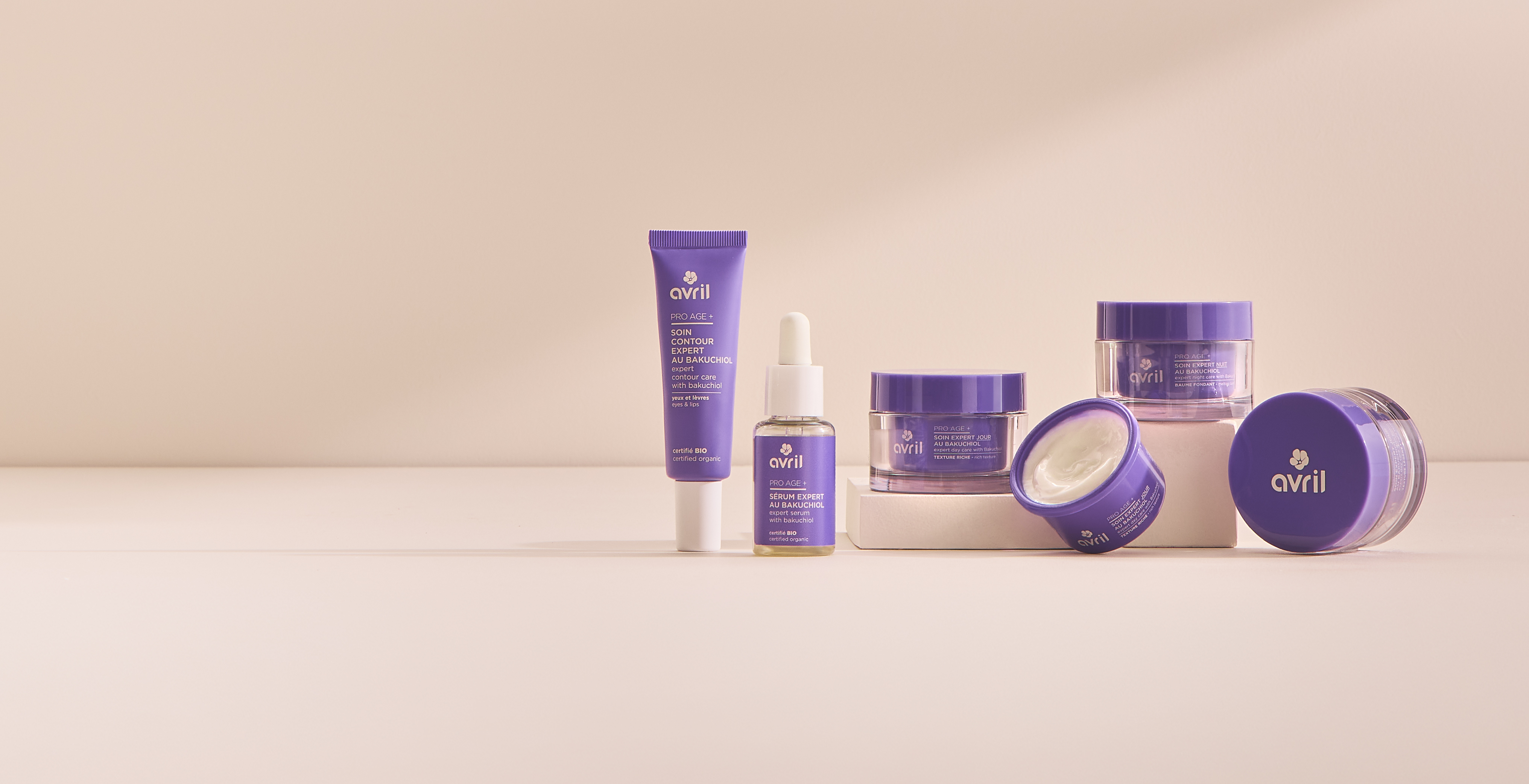
We created Pro Age + to enhance your skin, your story. At Avril, we don't promise to turn back time, we help you move forward with it. Because when you think about it… aging is a blessing!
And you, what has time brought you?
What are the effects of menopause on the skin?
The role of estrogens in the skin
Estrogen plays a role in the production of collagen and elastin, two essential proteins that give skin its firmness, suppleness, and elasticity!
It also contributes to:
- Maintaining good skin hydration,
- Supporting sebum production (which naturally protects the skin),
- Promoting good microcirculation,
- Optimizing the healing process.
This is why we often have beautiful skin around the time of ovulation, as this is the phase of the menstrual cycle when estrogen levels are at their highest!
Conversely, when estrogen levels drop, the skin can become thinner, drier, less plump, and sometimes more reactive. Furthermore, with the decrease in estrogen, the skin's pH tends to become more alkaline, which can compromise the skin barrier and explain why the skin retains less water. This can also exacerbate irritation, dryness, and skin sensitivity.
Some studies have even shown that after menopause, women lose approximately 30% of their skin collagen in the first five years following the hormonal drop, before the decline continues more gradually thereafter.
The most common skin changes during menopause
Among the most frequently observed skin-related side effects in menopausal women are:
- Dryer, more uncomfortable skin, with a feeling of tightness, especially after showering
- A loss of firmness and elasticity, with skin appearing thinner and wrinkles sometimes more pronounced
- More sensitive and reactive skin, prone to redness and irritation
- The return of acne, which can be partly explained by a greater influence of androgen (or "male") hormones, less balanced by estrogen
- The appearance or worsening of age spots.
Why do some women have more severe symptoms than others?
This can be perceived as a great injustice, as some women see their skin much more affected by menopause than the women around them. But why?
Genetics, yes, but not only that!
Genetics can certainly play a role in skin aging, but our lifestyle habits clearly have an impact as well!
Sun exposure
We naturally think of prolonged exposure to the sun's UV rays, which is one of the major causes of aging. UV rays accelerate the breakdown of collagen and elastin, and the skin can become thinner, less toned, more prone to wrinkles, fine lines, and age spots, and appear more quickly.
And it's not just a matter of sunburn: even chronic and moderate daily exposure (on a patio, in the car, walking, having lunch outside, etc.) can gradually contribute to this phenomenon. This is what we call photoaging, or skin aging linked to the sun.
UVA rays are particularly involved in this process because they penetrate deeply into the skin and generate oxidative stress, while UVB rays are more responsible for sunburn. Hence the importance of regular sun protection, even when it's not very hot or the sky is cloudy.
Alcohol
Alcohol can also contribute to skin aging through several mechanisms! First, it tends to promote dehydration: less hydrated skin often appears duller, less supple, and shows more fine lines and signs of fatigue! It's important to drink at least 1.5 liters of water a day to maintain sufficient hydration, both for your skin and your overall health.
Alcohol also increases oxidative stress, meaning the production of unstable molecules called free radicals, which can damage skin cells, collagen, and elastin. In the long term, this can contribute to a loss of firmness and accelerated skin aging.
It can also disrupt sleep, which plays a key role in the skin's repair and regeneration processes. Even if you fall asleep more easily after drinking, sleep quality is often poorer, with more micro-awakenings and less restorative deep sleep.
In some people, alcohol can also exacerbate redness and skin inflammation, particularly in cases of sensitive skin, rosacea, or inflammatory conditions. Furthermore, regular and heavy alcohol consumption can also be associated with nutritional deficiencies (antioxidants, B vitamins, zinc, etc.), which can indirectly affect skin health.
In short: it's not "one drink = wrinkles," of course, but chronic and heavy alcohol consumption can clearly contribute to skin aging.
Tobacco
Smoking is one of the factors most clearly associated with premature skin aging. Indeed, cigarette smoke contains thousands of chemical compounds capable of increasing oxidative stress and damaging skin cells.
Smoking notably promotes:
- the degradation of collagen and elastin;
- a decrease in blood microcirculation, resulting in a reduced supply of oxygen and nutrients;
- an increase in oxidative stress and inflammation
- a reduced capacity for skin repair.
As a result, the complexion can become duller, the skin thinner, and wrinkles more pronounced, especially around the mouth and eyes. Smoking is also associated with less effective wound healing and the worsening of certain inflammatory skin conditions!
Lack of sleep
During sleep, the body activates numerous cell repair and regeneration mechanisms: it is particularly during deep sleep that certain hormones involved in tissue repair are secreted in greater quantities!
When sleep is insufficient or of poor quality, it can lead to:
- an increase in cortisol (the stress hormone);
- increased inflammation and oxidative stress;
- impaired skin barrier function;
- reduced repair of damage accumulated during the day.
In practical terms, this can result in duller, more sensitive skin, more pronounced dark circles, reduced hydration, and sometimes an accentuation of signs of aging in the long term.
Chronic stress
Chronic stress also acts via several biological mechanisms, notably through the prolonged increase in cortisol. However, when it remains high for a long time, cortisol can disrupt the balance of the skin.
Chronic stress is particularly associated with:
- an increase in inflammation;
- more oxidative stress;
- an alteration of the skin barrier;
- sometimes disrupted sebum production;
- greater degradation of collagen.
In some people, it can also worsen existing skin problems, such as acne, eczema, psoriasis or rosacea. And obviously, stress, sleep, diet, alcohol or tobacco often tend to be self-perpetuating, which can create a cumulative effect on skin health.
An unbalanced diet
Diet can also influence skin aging, particularly through its impact on inflammation, oxidative stress, and the quality of skin tissue! A diet low in essential nutrients can weaken collagen production, impair skin hydration, and limit the skin's repair capacity.
Conversely, a diet rich in protein, healthy fats (such as omega-3s), fruits, vegetables, and antioxidant-rich foods appears to be associated with better overall skin health. Certain nutrients, such as vitamin C, play an important role in collagen synthesis and protection against oxidative stress.
Excessive consumption of refined sugars and ultra-processed foods could also promote certain mechanisms involved in skin aging, notably glycation, a process that can stiffen collagen and elastin fibers.
By listing these six factors that accelerate skin aging, we can better understand why genetics is just one factor among many! So, although the hormonal drop is inevitable and physiological, we still have some control over the quality of our skin during menopause by changing a few lifestyle habits! :)
And what about endocrine disruptors in all of this?
When hormones are mentioned, endocrine disruptors inevitably come to mind, and rightly so! As a reminder, endocrine disruptors are chemical molecules that can interfere with the hormonal system, either by mimicking our natural hormones or by blocking their receptors.
Of course, endocrine disruptors aren't responsible for menopause, but they can certainly create more chaos, especially during a pivotal period that's still rarely discussed: perimenopause!
Perimenopause (or pre-menopause) refers to the very gradual cessation of the menstrual cycle leading up to menopause, which can last several years (up to 10 years). This period is somewhat of a hormonal upheaval, with marked and sometimes unpredictable fluctuations that reflect the poor quality of hormonal communication between the brain and the ovaries. Again, this transition phase is normal, but it can be even more disrupted by endocrine disruptors!
This is a vast and complex subject, and many questions remain unanswered, particularly regarding the mechanisms involved in the menstrual cycle and female hormones, whether or not one is menopausal.
Nevertheless, we know that certain everyday products contain them, such as most conventional beauty and cosmetic products, scented candles and air fresheners, a large number of household products, and even plastic containers. To name just a few!
How to take care of your skin during menopause?
Returning to a simpler and gentler routine
In general, “less is more”: instead of accumulating cosmetic products, you can simplify your daily routine by choosing quality products.
Cleansing should be gentle (don't strip your skin!), avoid over-exfoliation, and be sure to nourish and hydrate your skin with a suitable oil or cream.
Sun protection becomes even more important
As mentioned, sunlight accelerates skin aging and can accentuate age spots and wrinkles during menopause, especially if you've already depleted your sun exposure reserves in the past!
It's therefore essential to protect your skin by using sunscreen daily, particularly when the UV index is above 3 (source) (and not just in summer!). Remember to also protect your face with a hat or cap whenever you're in the sun!
Do you need to change all your cosmetics during menopause?
Don't worry, the idea isn't for you to throw away all your cosmetics right away! It's just important to be aware that your products might not be as "clean" as you think and that it would be a good idea to replace some of them when they're finished. :)
To find out if your products are free of endocrine disruptors, you can scan them using INCI Beauty, which gives you a score out of 20 and highlights problematic ingredients.
And if you'd like to know how you stand in terms of exposure to endocrine disruptors (on your skin, but not only!), here's a quick quiz to assess your situation and leave with some concrete suggestions, without guilt or unrealistic demands!
We hope that this article has helped you to see things more clearly and better understand your skin if you have gone through menopause: it's the first step to taking care of it in the gentlest and most effective way possible!

About the author
This article was written by:
Laurène Sindicic
Speaker and Author
Fertility and Hormone Specialist
Creator of the Instagram account @emancipees.
Every purchase means 1% of the price is donated to the planet.